Nudge Theory in Healthcare: Small Changes, Big Impact
By DeltaMV Insights TeamReviewed by DeltaMV Academy EditorialUpdated 8 min read
Module 2 · 7 of 7Market Research Methodology & Behavioural Science FrameworksAll articles
- What Is Behavioural Science, and Why Does It Matter in Healthcare?
- Describe, Understand, Shape: DeltaMV’s Framework for Turning Data Into Decisions
- Designing a Good Research Question (Projects Often Fail Here)
- Sampling 101: Who You Talk to Determines What You Learn
- Make It Emotional, Make It Social, Make It Easy: DeltaMV’s Approach to Behaviour Change
- Health Belief Model & Theory of Planned Behaviour, Explained Simply
- Nudge Theory in Healthcare: Small Changes, Big Impact
Nudge theory in healthcare is the idea that a small change in how a choice is presented can make a better option more likely, without removing any options. This article focuses on designing nudges: four practical types, the evidence behind each, a step-by-step design approach, and the limits and ethics to keep in mind.
Key Takeaways
- A nudge changes how a choice is presented, not what the choices are. People stay free to choose differently.
- Nudge theory in healthcare offers four main types: defaults, simplification, prompts, and feedback.
- Nudges are cheap and quick to test, and they work within existing processes, which is why they are so popular with health systems.
- Effects vary by setting, and nudges work alongside good services, not in place of them.
- This article covers designing nudges. The biases that explain why they work are covered in Module 3.
What Is Nudge Theory in Healthcare?
The last article covered two academic models that explain why people act on their health. Nudge theory in healthcare takes a different route. It doesn’t try to change what people believe. It changes the setting in which they choose.
The idea comes from economist Richard Thaler and legal scholar Cass Sunstein. In their 2008 book Nudge, they described a nudge as any aspect of the choice architecture that alters behaviour in a predictable way, without forbidding options or significantly changing incentives. 1
“Choice architecture” simply means the way a choice is laid out: what is the default, how many steps there are, what is shown first, and when a prompt appears. A cafeteria that places fruit at eye level has designed a choice architecture.
Why Does It Matter in Healthcare?
Healthcare is full of decisions that happen at a particular moment: a doctor writing an order, a patient booking an appointment, a pharmacist handing over a prescription. A small change at that moment can affect thousands of decisions.
That is the particular appeal of nudges. They are usually cheap, they can be tested quickly, and they fit into existing systems. A health authority does not need new legislation or a large budget to try one.
Breaking Down the Toolbox
Many nudges can be grouped into four practical types.
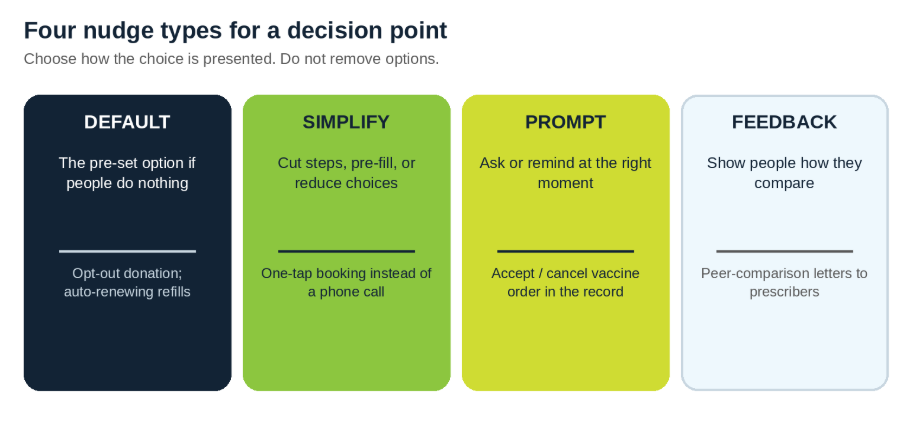
Figure 1. Four nudge types for a decision point. Grouping by DeltaMV, adapted from Sunstein’s ten important nudges.²
Default
A default is what happens if the person does nothing. Most people go with the pre-set option, so changing the default can shift outcomes a great deal.
Organ donation is the classic case. In a controlled experiment, about 42% of people chose to be donors when donation required an active opt-in, compared with 82% when it was the default. 3 In clinical settings, the same idea appears in order sets with the recommended option pre-selected.
Simplify
Simplifying means cutting steps, pre-filling information, or reducing the number of options. A large US experiment outside healthcare shows how powerful this can be: helping low-income families complete a college aid form, using pre-filled tax data, increased the likelihood that their children went to college by about 25%. 4 In health, the equivalent is a one-tap booking link instead of a phone call.
Prompt
A prompt asks, or reminds, at the moment of decision. It works especially well when the prompt requires a response.
A US health system asked clinicians to actively “accept” or “cancel” a flu vaccine order for each eligible patient. Vaccination orders rose by 6.6 percentage points more than in clinics without the prompt. 5 In the UK, text reminders that included the person’s name raised the average value of fine repayments by more than 30%. 6 The same principle applies to appointment reminders.
Feedback
Feedback shows people how they compare with their peers, or with a goal. It is widely used with prescribers.
In a US trial, peer-comparison letters were sent to about 5,000 high-volume primary care prescribers of the antipsychotic quetiapine in Medicare. Over nine months, prescribing fell in the group that received the letters compared with the group that did not, without any detectable adverse impacts.7
How to Design a Nudge: Step by Step
- Pick one decision point. For example: when a clinician writes an order, or when a patient is offered an appointment. Be specific about who, what, and when.
- Choose the nudge type. Match it to what is going on at that point. Is the right option hard to choose (simplify, default), forgotten (prompt), or invisible to the person (feedback)?
- Design it with the person in mind. Keep it short, make it easy to act on, and make sure the better option is genuinely better for them.
- Keep the opt-out easy. People must remain free to choose differently, and they should know how.
- Test it against the current process. Run the nudge alongside the existing version, with a control group where possible.
- Measure and refine. Track the behaviour, not just opinions. Adjust, and re-test.
An Illustrative Example
The example below is generalised. It is not a specific client or project. A clinic wants more eligible patients to attend a screening appointment.
| Nudge | What the clinic might change | What it replaces |
|---|---|---|
| Default | Book a provisional slot for the patient, who can change or cancel it. | Patient has to ask for an appointment. |
| Simplify | Send a link where one tap confirms the slot. | A phone call during office hours. |
| Prompt | Send a text with the patient’s name two days before. | No reminder. |
| Feedback | Show each clinic how its attendance compares with similar clinics. | Clinics only see their own figures. |
The clinic would not use all four at once. It would start with the nudge that best fits its main barrier, test it, and then decide what to add.
The Cheat Sheet
Nudge theory in healthcare says a small change to how a choice is presented can make the better option more likely, while leaving people free to choose. Four types do most of the work: set a helpful default, make it simpler, prompt at the right moment, or show how people compare. Always test, and always keep the opt-out easy.
Common Mistakes
- Using a nudge to fix a bigger problem. If a service is hard to reach or poor quality, a nudge won’t rescue it.
- Making the opt-out hard. A default that traps people is no longer a nudge. People must be able to choose otherwise easily.
- Expecting the same effect everywhere Effects differ between studies and settings. Test locally
- Forgetting to measure. Without a comparison group, it is hard to tell whether a change worked.
- Not being transparent. A nudge should be something you could explain openly to the people it affects, and it should serve their own goals.
A DeltaMV Perspective
DeltaMV places nudges within its three levers.
Prompts and messages framed around what matters to the person, such as a reminder that speaks to staying well rather than to a schedule, sit under Make It Emotional.
Peer-comparison feedback to prescribers sits under Make It Social, because it makes behaviour visible and comparable with colleagues.
Defaults and simplifications sit under Make It Easy. In our work, choice architecture, which means changing how a choice is presented, is one expression of Make It Easy: stripping friction out of the moment between intention and action.
Seen this way, nudge theory in healthcare is not a separate method. It is a set of design techniques that can be used inside the same framework. The final article in this module shows how DeltaMV packages behavioural principles like these into a deck of cards that teams can use to generate ideas.
FAQs
Is a nudge the same as a rule or an incentive?
No. A rule forbids or requires something, and an incentive changes the cost or reward. A nudge changes only how the choice is presented and leaves every option available.
Are nudges ethical?
They can be, when they serve the person’s own interests, are open to scrutiny, and allow easy opt-out. A nudge that works against someone’s interests, or hides how it works, crosses the line.
Do nudges last?
Sometimes the effect fades, especially when feedback is not repeated. Plan to measure over time and refresh the nudge when needed.
Do I need to understand the biases behind nudges to use them?
Not to get started. Testing shows what works. Module 3 covers the biases for readers who want to understand why.
The Bottom Line
Nudge theory in healthcare comes down to small, low-cost changes to how a choice is presented. Pick one decision point, choose the right type, keep the opt-out easy, and test it. Small changes can make a measurable difference.
Sources
- Thaler, R. H., & Sunstein, C. R. (2008). Nudge: Improving decisions about health, wealth, and happiness. Yale University Press.
- Sunstein, C. R. (2014). Nudging: A very short guide. Journal of Consumer Policy, 37(4), 583–588. https://doi.org/10.1007/s10603-014-9273-1
- Johnson, E. J., & Goldstein, D. (2003). Do defaults save lives? Science, 302(5649), 1338–1339. https://doi.org/10.1126/science.1091721
- Bettinger, E. P., Long, B. T., Oreopoulos, P., & Sanbonmatsu, L. (2012). The role of application assistance and information in college decisions: Results from the H&R Block FAFSA experiment. The Quarterly Journal of Economics, 127(3), 1205–1242. https://doi.org/10.1093/qje/qjs017
- Patel, M. S., Volpp, K. G., Small, D. S., Wynne, C., Zhu, J., Yang, L., Honeywell, S., Jr., & Day, S. C. (2017). Using active choice within the electronic health record to increase influenza vaccination rates. Journal of General Internal Medicine, 32(7), 790–795. https://doi.org/10.1007/s11606-017-4046-6
- Haynes, L., Service, O., Goldacre, B., & Torgerson, D. (2012). Test, learn, adapt: Developing public policy with randomised controlled trials. Cabinet Office Behavioural Insights Team. https://www.gov.uk/government/publications/test-learn-adapt-developing-public-policy-with-randomised-controlled-trials
- Sacarny, A., Barnett, M. L., Le, J., Tetkoski, F., Yokum, D., & Agrawal, S. (2018). Effect of peer comparison letters for high-volume primary care prescribers of quetiapine in older and disabled adults: A randomized clinical trial. JAMA Psychiatry, 75(10), 1003–1011. https://doi.org/10.1001/jamapsychiatry.2018.1867
- O’Connor, D. A., Glasziou, P., Maher, C. G., McCaffery, K. J., Schram, D., Maguire, B., Ma, R., Billot, L., Gorelik, A., Traeger, A. C., Albarqouni, L., Checketts, J., Vyas, P., Clark, B., & Buchbinder, R. (2022). Effect of an individualized audit and feedback intervention on rates of musculoskeletal diagnostic imaging requests by Australian general practitioners: A randomized clinical trial. JAMA, 328(9), 850–860. https://doi.org/10.1001/jama.2022.14587