Health Belief Model & Theory of Planned Behaviour, Explained Simply
By DeltaMV Insights TeamReviewed by DeltaMV Academy EditorialUpdated 7 min read
Module 2 · 6 of 7Market Research Methodology & Behavioural Science FrameworksAll articles
- What Is Behavioural Science, and Why Does It Matter in Healthcare?
- Describe, Understand, Shape: DeltaMV’s Framework for Turning Data Into Decisions
- Designing a Good Research Question (Projects Often Fail Here)
- Sampling 101: Who You Talk to Determines What You Learn
- Make It Emotional, Make It Social, Make It Easy: DeltaMV’s Approach to Behaviour Change
- Health Belief Model & Theory of Planned Behaviour, Explained Simply
- Nudge Theory in Healthcare: Small Changes, Big Impact
The Health Belief Model and the Theory of Planned Behaviour are two classic academic models of why people do or don’t act on their health. One focuses on how people see a health threat. The other focuses on intention. This article explains both in plain language, with a worked example and their limits.
Key Takeaways
- The Health Belief Model (HBM) says people act when they see a health threat as real and serious, believe action will help, and think the barriers are manageable.
- The Theory of Planned Behaviour (TPB) says behaviour follows intention, and intention comes from a person’s attitude, the norms around them, and how much control they feel they have.
- Both are academic models developed over the decades. DeltaMV’s three levers are a practical menu for action, while these two are explanations that researchers and public health teams widely use.
- Both focus on conscious reasoning. They are less good at explaining habits, emotions, and the gap between intention and action.
- They are most useful for designing research questions and survey items and for reading the published literature.
What Are These Two Models?
The last article introduced DeltaMV’s three levers: a practical menu of ways to change behaviour. The two models in this article are different. They come from academic research, and they aim to explain why people act on their health, or don’t.
Both are widely used, which means you will meet them in journal papers, public health programmes, and the questionnaires behind many surveys. Knowing the basics makes that work much easier to read.
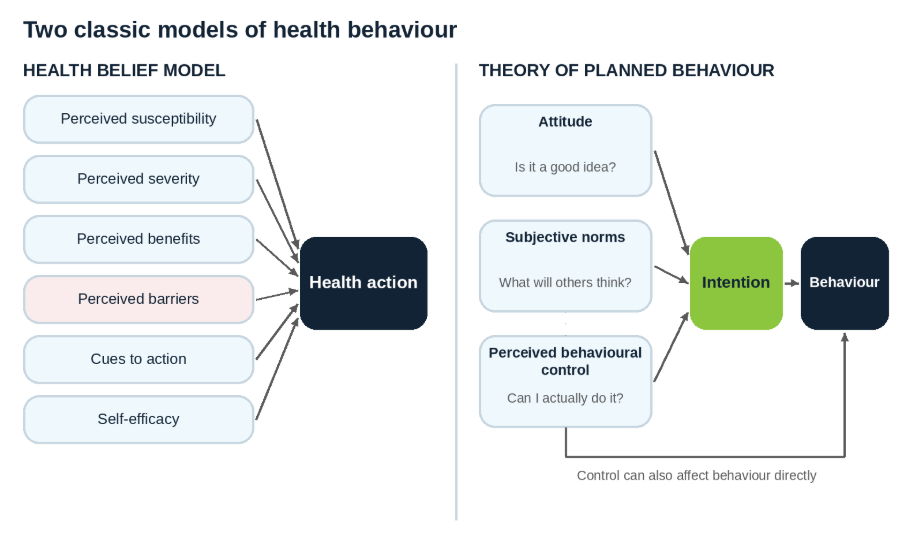
Figure 1. The two models side by side.
Why Do They Matter?
These two models matter for a reason that is different from the frameworks before them. They provide a shared vocabulary. When a public health body, a regulator, or a university team talks about “perceived barriers” or “subjective norms,” they are using these models.
They also give researchers a ready-made list of things to measure. Instead of starting with a blank page, a team can ask: how serious do people think this is, do they believe the treatment works, and what do people around them think?
Breaking Down the Models
The Health Belief Model
The HBM was developed in the 1950s by social psychologists working for the US Public Health Service. 1 They wanted to understand why so many people did not take up free health screening. It rests on beliefs, and has six parts:
- Perceived susceptibility: “Could this happen to me?”
- Perceived severity: “How serious would it be?”
- Perceived benefits: “Will taking action help?”
- Perceived barriers: “What would it cost me in money, time, effort, or worry?”
- Cues to action: a trigger that prompts action, such as a reminder, a symptom, or a conversation.
- Self-efficacy: “Do I feel able to do it?”
In simple terms, people act when they feel at risk, think the problem is serious, believe the action works, and feel the barriers are small enough to overcome.
The Theory of Planned Behaviour
The TPB was developed by psychologist Icek Ajzen and published in 1991. 2 It grew out of an earlier theory, and it puts intention at the centre. Intention is shaped by three things:
- Attitude: “Do I think this is a good idea?”
- Subjective norms: “Do people who matter to me think I should do it?”
- Perceived behavioural control: “Do I believe I can actually do it?”
Intention then leads to behaviour. The model also allows perceived control to affect behaviour directly, because someone who knows they can’t do something is unlikely to try, whatever they intend.
How They Compare
| Health Belief Model | Theory of Planned Behaviour | |
|---|---|---|
| Starting point | How a person sees a health threat and the action to deal with it | A person’s intention to act |
| Strongest on | Perceived risk, barriers, and benefits | The role of other people’s views and a person’s sense of control |
| Best used for | Preventive health: screening, vaccination, check-ups | Almost any behaviour, including by professionals |
| Shared limit | Mostly about conscious reasoning, so less able to explain habits and emotions | Mostly about conscious reasoning, so less able to explain habits and emotions |
An Illustrative Example
Here is the same illustrative case seen through both models. It is not a specific client or project. An adult is deciding whether to get a yearly flu vaccine.
| Model part | What it might look like |
|---|---|
| HBM: susceptibility and severity | “I rarely get ill, and flu is usually mild for me.” |
| HBM: benefits and barriers | “It probably helps, but it means taking time off and I don’t like needles.” |
| HBM: cue to action | “My clinic sent a text reminder.” |
| TPB: attitude | “Vaccines are generally a good idea.” |
| TPB: subjective norms | “Nobody at my workplace bothers.” |
| TPB: perceived control | “I don’t know how to book, or whether I qualify.” |
Each model highlights something the other puts less weight on. The HBM shows that the person doesn’t feel at risk. The TPB shows that the social setting and a sense of not knowing how to book are working against them. Together they give a fuller picture than either alone.
Using the Models in Research
The most common use is to turn the model parts into survey items or interview prompts. For example, you might ask people to rate how much they agree with statements about risk, benefit, and barriers, then see which ones differ most between those who act and those who don’t.
Do this with care. Wording should be tested locally, because beliefs and norms vary between countries and communities. A question that works in one market may not carry the same meaning in another.
The Cheat Sheet
These two models explain health choices through what people believe. One looks at how real and serious a health risk seems, and whether the benefits outweigh the barriers. The other looks at whether someone intends to act, based on their own view, the views of others, and how much control they feel. Both are useful, but neither explains everything.
Common Mistakes
- Treating intention as behaviour. People often intend to act and don’t. Research reviews show that even large changes in intention lead to smaller changes in what people actually do. 3
- Using the models as checklists. Not every part matters equally in every setting. Look at which ones actually separate those who act from those who don’t.
- Copying questionnaires across cultures. Wording and the weight of social norms can differ. Pilot first.
- Overlooking habits and emotions. Both models assume people weigh things up. In real life, a lot of health behaviour is automatic.
- Mixing up the two. The HBM starts from perceived threat. The TPB starts from intention. They suit different questions.
A DeltaMV Perspective
Imagine a survey in which most people hold a positive view of a preventive treatment, yet few take it up. A model that stops at attitude would be puzzled.
Seen through the TPB, the gap becomes easier to explain. Attitude is high, but perceived control is low, because people are unsure how to access the treatment, and norms are weak, because few others around them have taken it.
The finding points to action on access and social visibility, rather than yet another message about benefits. The model supplies the questions to ask. It is then up to the team to choose and test the response.
FAQs
Which model is better?
Neither is better overall. The HBM suits questions about perceived risk and prevention. The TPB suits questions about intention and social influence. Many studies use elements of both.
Are these models still used?
Yes. They remain among the most widely cited in health behaviour research, though many researchers now add habits, emotions, and context to them.
Do they predict behaviour well?
Only partly. Evidence for both is mixed, and each explains a share of behaviour, not all of it. This is why they are often combined with other approaches.
How do these relate to the three levers?
The levers give a menu of actions. HBM and TPB are older academic models that explain people’s reasoning. They can help you decide what to ask about.
The Bottom Line
The Health Belief Model and the Theory of Planned Behaviour explain health choices through beliefs and intentions. They give a useful vocabulary and a ready list of things to measure, but they work best alongside tools that also account for habits, emotions, and context.
Sources
- Rosenstock, I. M. (1974). Historical origins of the health belief model. Health Education Monographs, 2(4), 328–335. https://doi.org/10.1177/109019817400200403
- Ajzen, I. (1991). The theory of planned behavior. Organizational Behavior and Human Decision Processes, 50(2), 179–211. https://doi.org/10.1016/0749-5978(91)90020-T
- Webb, T. L., & Sheeran, P. (2006). Does changing behavioral intentions engender behavior change? A meta-analysis of the experimental evidence. Psychological Bulletin, 132(2), 249–268. https://doi.org/10.1037/0033-2909.132.2.249