Make It Emotional, Make It Social, Make It Easy: DeltaMV’s Approach to Behaviour Change
By DeltaMV Insights TeamReviewed by DeltaMV Academy EditorialUpdated 6 min read
Module 2 · 5 of 7Market Research Methodology & Behavioural Science FrameworksAll articles
- What Is Behavioural Science, and Why Does It Matter in Healthcare?
- Describe, Understand, Shape: DeltaMV’s Framework for Turning Data Into Decisions
- Designing a Good Research Question (Projects Often Fail Here)
- Sampling 101: Who You Talk to Determines What You Learn
- Make It Emotional, Make It Social, Make It Easy: DeltaMV’s Approach to Behaviour Change
- Health Belief Model & Theory of Planned Behaviour, Explained Simply
- Nudge Theory in Healthcare: Small Changes, Big Impact
Make It Emotional, Make It Social, Make It Easy is DeltaMV’s own menu of three levers for changing behaviour. It boils down over 150 known biases into three practical questions a team can act on. This article explains each lever, how to choose between them, and where teams go wrong.
Key Takeaways
- DeltaMV groups the many ways of influencing behaviour into three levers: Make It Emotional, Make It Social, and Make It Easy.
- They are a menu of what to try.
- Emotional connects with the stakes that really drive a decision. Social uses the influence of peers. Easy removes friction.
- The levers work best when chosen after a diagnosis of the barrier, not at random.
What Are the Three Levers?
Once a team has worked out why a behaviour isn’t happening, the next question is what to do about it. That is where DeltaMV’s three levers come in.
Behavioural science has identified well over a hundred biases and shortcuts. That is too many for a team to hold in their heads during a workshop. DeltaMV distilled them into three levers:
- Make It Emotional: move past a features-and-data pitch to the emotional stakes that actually drive a decision.
- Make It Social: use the peer influence and networks that a person already trusts.
- Make It Easy: remove the practical friction that sits between intention and action.
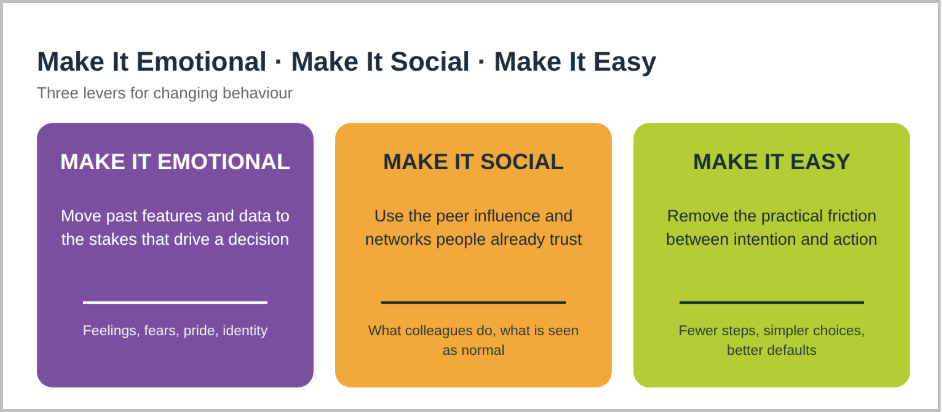
Figure 1. DeltaMV’s three behaviour-change levers.
Why Does It Matter?
A long list of biases is useful for specialists but hard for a brand team or a health programme to use. The three levers give people a shared, simple language for ideas.
That has a practical effect. In a workshop, “can we make this more emotional, more social, or easier?” is a question anyone can answer. It also sets up a quick check on a plan: does it use at least one of the three levers, and does it use the right one for the barrier?
The levers also protect against a common habit. Many teams default to one kind of action, usually more information or more data. The three levers push a team to look at the other two.
Breaking Down the Framework
Make It Emotional
This lever asks: what is really at stake for this person, and does our message speak to it? Decisions that look rational are often driven by feelings such as fear, pride, trust, or worry about regret.
Typical moves include framing a choice around what someone could lose, tying a feature to a benefit that matters in daily life, and telling a story, not listing a fact. In Japan, cancer screening invitations that used loss-framed wording for lower-concern groups raised participation by 2.6 percentage points across 787 municipalities 1.
Make It Social
This lever asks: what are the people around them doing, and who do they listen to? Most people, including doctors, take cues from peers.
Typical moves include showing how someone compares with similar colleagues, sharing stories from trusted peers, and building on existing networks. In a UK trial, GPs who were high prescribers of antibiotics received a letter comparing them with their peers. Prescribing fell by 3.3%. 2 An Australian programme using a similar approach reported a 12.3% fall among high prescribers over six months. 3 Results vary by setting, but the direction is consistent.
Make It Easy
This lever asks: what is making the right action hard? Effort is a powerful barrier, and it is often invisible to the people who designed the process.
Typical moves include removing steps, setting a sensible default, pre-filling forms, and making the right choice the simplest one. In one US health system, clinicians were prompted to actively accept or cancel a flu vaccine order for each eligible patient. Vaccination orders rose by 6.6 percentage points more than in clinics without the prompt. 4 The vaccine and the advice were the same. Only the effort changed.
Choosing Between the Levers
Start from the barrier, then pick the lever that fits it. The table below shows a simple way to think about it, using one illustrative problem: patients who stop treatment after the first refill. It is a generalised example, not a specific client or project.
| Lever | Question to ask | An idea it might prompt |
|---|---|---|
| Make It Emotional | What is at stake for them personally? | A message about what staying well makes possible, in place of a list of dosing instructions. |
| Make It Social | Who do patients trust and look to? | Short stories from patients who stayed on treatment, shared through a trusted community. |
| Make It Easy | What effort or friction gets in the way? | Automatic refill reminders and one-tap reordering. |
The three ideas are not rivals. The strongest plans often draw on all three, with one lever leading and the others in support. But it helps to be clear which barrier each idea is aimed at.
The Cheat Sheet
To change behaviour, try one of three things. Make it matter to the person, make it feel normal because others do it, or make it easier to do. Look at what is holding people back first, and then choose the lever that fits.
Common Mistakes
- Using all three without a priority. A plan that does a bit of everything often does nothing well. Choose the main lever and use the others to support it.
- Reaching for the lever you like best. Teams often favour emotional storytelling or data. Match the lever to the barrier instead.
- Treating Emotional as hype. It is about the real stakes for a person, not exaggeration. In healthcare, messages must stay accurate, supportive, and compliant.
- Skipping the diagnosis. If you haven’t worked out why people aren’t acting, any lever is a guess.
- Not testing. Effects vary by setting. Compare the new approach with the old one, even if only on a small scale.
A DeltaMV Perspective
These three levers are the backbone of DeltaMV’s behaviour change work. We have distilled more than 150 cognitive biases into these three practical levers.
They are also the foundation of our AdoptToolkit, DeltaMV’s card deck for influencing prescribing and patient behaviour. The original deck is organised around the three levers, and the final article in this module covers our latest Journey Edition, which maps its cards onto eight stages of treatment adoption.
Because the same language runs through workshops, tools, and outputs, a team that has used the three levers once can use them again without learning a new method.
FAQs
Is Make It Emotional manipulative?
It shouldn’t be. The aim is to connect with what matters to a person, truthfully. Good practice keeps messages accurate and proportionate and keeps people free to choose.
Can I use the levers for patients and for doctors?
Yes. They apply to anyone who makes a decision, including prescribers, patients, pharmacists, and payers.
The Bottom Line
Make It Emotional, Make It Social, and Make It Easy turn a long list of biases into three questions any team can use. Diagnose the barrier first, then choose the lever that fits it.
Sources
- Mizota, Y., & Yamamoto, S. (2021). Rainbow of KIBOU project: Effectiveness of invitation materials for improving cancer screening rate using social marketing and behavioral economics approaches. Social Science & Medicine, 279, Article 113961. https://doi.org/10.1016/j.socscimed.2021.113961
- Hallsworth, M., Chadborn, T., Sallis, A., Sanders, M., Berry, D., Greaves, F., Clements, L., & Davies, S. C. (2016). Provision of social norm feedback to high prescribers of antibiotics in general practice: A pragmatic national randomised controlled trial. The Lancet, 387(10029), 1743–1752. https://doi.org/10.1016/S0140-6736(16)00215-4
- Behavioural Economics Team of the Australian Government. (2018). Nudge vs superbugs: A behavioural economics trial to reduce the overprescribing of antibiotics. Department of the Prime Minister and Cabinet. https://www.pmc.gov.au/sites/default/files/2025-06/report-nudge-vs-superbugs.pdf
- Patel, M. S., Volpp, K. G., Small, D. S., Wynne, C., Zhu, J., Yang, L., Honeywell, S., Jr., & Day, S. C. (2017). Using active choice within the electronic health record to increase influenza vaccination rates. Journal of General Internal Medicine, 32(7), 790–795. https://doi.org/10.1007/s11606-017-4046-6