Describe, Understand, Shape: DeltaMV’s Framework for Turning Data Into Decisions
By DeltaMV Insights TeamReviewed by DeltaMV Academy EditorialUpdated 7 min read
Module 2 · 2 of 7Market Research Methodology & Behavioural Science FrameworksAll articles
- What Is Behavioural Science, and Why Does It Matter in Healthcare?
- Describe, Understand, Shape: DeltaMV’s Framework for Turning Data Into Decisions
- Designing a Good Research Question (Projects Often Fail Here)
- Sampling 101: Who You Talk to Determines What You Learn
- Make It Emotional, Make It Social, Make It Easy: DeltaMV’s Approach to Behaviour Change
- Health Belief Model & Theory of Planned Behaviour, Explained Simply
- Nudge Theory in Healthcare: Small Changes, Big Impact
Describe, Understand, Shape is DeltaMV’s own process for turning research data into decisions. First describe what is happening, then understand why it is happening, then shape what to do about it. This article explains each step, why the last one matters most, and the mistakes that stop research from changing anything.
Key Takeaways
- “Market research” is an umbrella term, not one method. It spans qualitative and quantitative work, primary and secondary sources, and studies run for very different purposes.
- Its real job isn’t collecting data. It’s reducing uncertainty enough that a decision can be made with confidence.
- Healthcare research carries extra layers most consumer research doesn’t, including regulation, multiple stakeholders such as physicians, patients, and payers, and decisions that aren’t always rational.
- Good research starts from a specific decision, not a general curiosity about “what people think.”
- This article is the anchor for DeltaMV Academy’s Module 1. Every other module in this series maps back to a piece of the landscape introduced here.
What Is Describe, Understand, Shape?
The first article in this module defined behavioural science in general: the study of how people really decide and act. Describe, Understand, Shape is different. It is not a theory of behaviour. It is DeltaMV’s way of running research so that the findings lead to something being done.
It has three steps:
- Describe: what is happening?
- Understand: why is it happening?
- Shape: what should we do about it?
That is the whole idea. The value lies in doing all three, in order, and not stopping early.
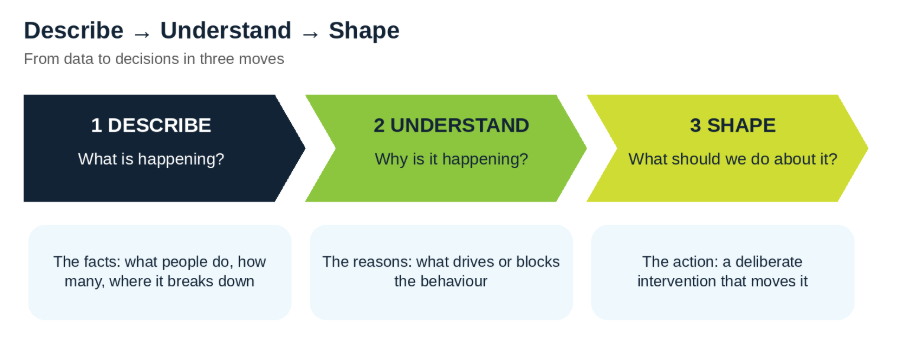
Figure 1. The three steps of Describe, Understand, Shape.
Why Does It Matter?
Most research reports are good at describing. They show sales, awareness, preference scores, and how groups differ. That is useful. But a description alone does not tell a team what to do next.
This is the gap Describe, Understand, Shape is built to close. It treats research as a route to a decision, not as an end in itself.
The framework earns its place in three ways:
- It stops the report from being the finish line. The question changes from “what did we find?” to “what will we do?”
- It separates facts from reasons. Knowing that doctors stop prescribing is not the same as knowing why. Acting on the first without the second is guesswork.
- It makes action testable. A shaped intervention is a specific change you can try, measure, and improve.
Breaking Down the Framework
Step 1: Describe
Describe answers one question: what is actually happening? It is about facts. How many people do this? Where in the journey do they drop off? How do different groups compare?
At this step, you are looking for the pattern, not the explanation. Typical sources include trackers, sales and prescribing data, surveys, and secondary research. If you read Qualitative vs Quantitative Research in Module 1, this step leans on the “how many” side.
A good Describe ends with a clear, specific statement of the pattern. For example: “Many doctors try the treatment once, but few go on to use it regularly.”
Step 2: Understand
Understand asks: why is it happening? Now you look for the reasons behind the pattern. What makes the behaviour easier or harder? What do people believe, fear, or assume? What is going on in their day that you can’t see in the data?
This is where the “why” questions are asked, usually through interviews, observation, or open conversation. It is also where behavioural frameworks come in. The next articles in this module introduce several that can structure this step.
A good Understand ends with a short list of reasons, ranked by how much they matter. “Doctors are unsure which patients suit the treatment, and worry about the extra follow-up” is a reason. “Doctors have mixed feelings” is not.
Step 3: Shape
Shape asks: what should we do about it? This is the step that turns understanding into action. It is the part many studies miss.
To shape something, you design a specific intervention aimed at one of the reasons you found. It might be a change to a process, a message, a tool, or the order in which people see things. Then you test it, see what happens, and refine it.
A good Shape ends with an action that has an owner, a date, and a way of measuring whether it worked.
How the Steps Connect
Each step feeds the next. The pattern from Describe tells you where to look for reasons. The reasons from Understand tell you what an intervention should aim at. The result of the test in Shape tells you whether you have the pattern and the reasons right.
A simple way to check which step a team is really in is to listen to what people say in the meeting:
- “How many…?” or “Where do they drop off…?” means you are still describing.
- “Why do they…?” or “What stops them…?” means you are in Understand.
- “What if we tried…?” or “How will we know it worked…?” means you have reached Shape.
If a project plan has plenty of the first kind of question and none of the last, the third step is probably missing.
An Illustrative Example
The example below is generalised. It is not a specific client or project.
| Step | What the team does | What the team does |
|---|---|---|
| Describe | Reviews prescribing data for a newer treatment. | Many doctors prescribe it once or twice, then stop. |
| Understand | Interviews doctors who tried it and stopped. | They are unsure which patients suit it, and worry about extra follow-up. |
| Shape | Designs a simple patient-selection guide and a follow-up reminder, then tests them with a small group. | A defined action with a way to measure whether continued prescribing rises. |
Without the middle step, the team might have run a general awareness campaign. Without the last step, it would have a good report and the same problem.
The Cheat Sheet
Don’t stop at the facts. First, describe what is happening. Then find out why. Finally, decide what to do about it, and test it. Many studies only do the first part. The value comes from the third.
Common Mistakes
- Stopping at Describe. A clear picture of the market feels like progress, but it does not change anything on its own.
- Jumping from Describe to ideas. Without the “why”, interventions are guesses. Someone has a good idea, and it gets built without checking it targets the real cause.
- Treating Shape as a brainstorm. A list of ideas is not an intervention. Pick one reason, design one specific action, and decide how you will measure it.
- Treating it as a straight line. What you learn when you test an action often changes the picture. Be ready to go back to the first or second step.
- Skipping the test. An intervention that is never measured can’t teach you anything, whether it works or not.
A DeltaMV Perspective
DeltaMV presents Describe, Understand, Shape as its point of difference from traditional market research. In its own words, the “Shape” step, “turning insight into a deliberate intervention,” is what defines the practice.
That emphasis shows up in how its behavioural work is delivered. Behavioural mapping workshops identify the challenges along a treatment adoption journey, and then apply behavioural science tools to build strategies with measurable business impact. The outputs are practical: clinician personas, emotional benefits and pain points, positioning statements, selling stories, and call-opening questions.
The pattern is consistent. Research is not finished when the findings are presented. It is finished when there is something concrete to try.
FAQs
How is this different from traditional market research?
Traditional research often ends at describing and understanding. Describe, Understand, Shape adds a third, deliberate step: designing and testing an intervention based on what the research found.
Do I need all three steps on every project?
Not always. Sometimes you already know the pattern and only need the reasons. But if the aim is to change behaviour, skipping the final step usually means the work stops short.
Where do other behavioural frameworks fit in?
They help most at the Understand step, by giving structure to the reasons behind a behaviour. They are covered in the next articles in this module.
How long does it take?
It depends on the project. A small, focused study can move through all three steps within weeks. The Shape step takes longest when an intervention needs to be tested properly.
The Bottom Line
Describe, Understand, Shape moves research from “here is what we found” to “here is what we will do.” Doing all three steps, in order, is what turns data into a decision.