Loss Aversion Nudge Marketing: What It Is and How to Use It
By DeltaMV Insights TeamUpdated 5 min read
Marketers often focus on what customers stand to gain – yet people are far more motivated by what they might lose. Loss aversion nudge marketing uses that bias: framing a message around what someone stands to lose by doing nothing can change behaviour without a bigger discount, a better product or a new offer. This article explains loss aversion, practical gain-versus-loss examples, evidence from Japan, and how to build it into your team’s playbook.
Key takeaways
- Losses hurt about twice as much as equivalent gains make us happy.
- Loss-framed cancer screening invitations in Japan lifted participation by 2.6 percentage points.
- Changing the frame works on existing messaging, offers and budgets.
What Is a Nudge?
A nudge is any marketing action built around one of the short-cuts people use in everyday decision-making. Several governments now have their own ‘nudge units’, and behavioural science has identified well over a hundred of these short-cuts. This article focuses on one: loss aversion. For another, see choice architecture.
What Is Loss Aversion?
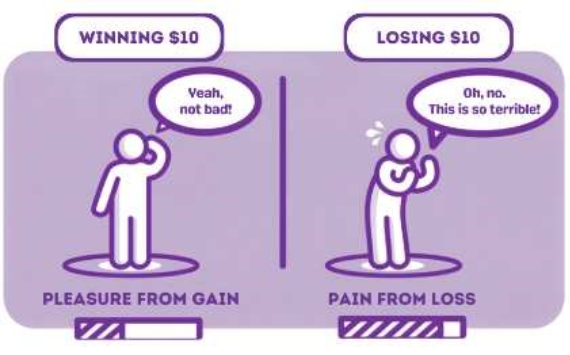
Loss aversion is the idea that losses loom larger than gains: losing $10 is more compelling than winning $10, and losses hurt about twice as much as equivalent gains make us happy1. Its basis lies in emotional regions of the brain – the insula and the amygdala – rather than in the deliberate parts we use to weigh up costs and benefits.
It helps to separate two terms: loss aversion is the bias, while loss framing is the messaging technique that uses it by describing a choice in terms of what someone could lose.
Why Do Losses Loom Larger Than Gains?
Because people judge outcomes relative to a reference point – usually what they already have or expect – and a move below it registers as a loss weighted roughly twice as heavily as an equivalent gain1. This is closely related to the endowment effect, the tendency to value something more simply because we own it. It also has an evolutionary logic: failing to react to a potential loss of food or shelter was far more costly than missing an equivalent gain.
How to Use Loss Aversion in Nudge Marketing
Create a sense of ownership, or communicate what customers stand to lose by not acting. The table shows the same message in each frame.
| Situation | Gain frame (what you get) | Loss frame (what you lose) |
|---|---|---|
| Free trial | “Enjoy our product for 30 days.” | “Try it for 30 days and send it back if you’re not happy.” |
| EDM headline | “Inside this issue: the latest updates.” | What the reader stands to lose by not opening the email. |
| Loyalty programme | “Earn a reward each time you engage.” | A notional reward upfront, discounted as engagement drops. |
| Patient concordance | “Better health outcomes.” | What ill health could cost – financially, in quality of life, or in relationships. |
Gain-frame wording is illustrative.
Customers, clinicians and patients care about more than your product, so you can also talk about the financial, emotional or social consequences of not acting. For an adherence example, see how Wellth uses loss aversion.
Does Loss Framing Work? A Cancer Screening Case From Japan
- Yes. Japan’s “Rainbow of KIBOU” project showed that loss-framed invitations lifted cancer screening at national scale.
- Context: 787 municipalities, 2015–2018.
- Intervention: screening invitations for five cancers were redesigned using social marketing and behavioural economics. For lower-concern segments, they used loss framing – lines like “1 in 10 people get breast cancer” and “the mortality rate is 40% if not detected early”.
- Result: participation rose by 2.6 percentage points – a 1.44-fold increase – and 83% of the 167 municipalities studied saw rates rise2.
- Lesson for practice: with 4.3 million residents reached, a few points means many more people screened – from changing the frame, not the offer.
Want your team to write messaging like this? DeltaMV’s Marketing Excellence Training turns behavioural science into campaigns.
It’s one of the cheapest changes a marketing or health communications team can make – it works on existing messaging, offers and budgets, as we also explore in why discounts may devalue your product.
What Are the Limitations of Loss Aversion Nudges?
- Effects can be modest: a 2.6-point lift matters at scale, but isn’t a transformation on its own.
- Match the frame to the audience: Japan used loss framing for lower-concern segments, not everyone.
- Use responsibly in health: messages must be accurate, supportive and compliant.
Frequently Asked Questions
What is loss aversion in marketing?
The tendency to feel losses more than equal gains – used by framing messages around what customers lose by not acting.
Does loss framing work in healthcare?
Yes. In Japan, loss-framed screening invitations lifted participation by 2.6 percentage points2.
Can loss framing backfire?
Yes. Overused or exaggerated loss messages can feel manipulative and erode trust, especially in healthcare. Keep the potential loss real and proportionate, test it against a gain-framed version, and match the frame to the audience rather than applying it to everyone.
Next Steps: Build Loss Aversion Into Your Team’s Playbook
DeltaMV’s Marketing Excellence Training builds this thinking in. Our Behavioural Science Fundamentals module walks brand, medical and sales teams through loss aversion and the other biases that drive HCP and patient decisions, and our Developing Compelling Content module turns it into headlines, EDMs and campaigns your team can write and test themselves.
Want your team writing loss-framed messaging on their next campaign? Get in touch with DeltaMV’s Marketing Excellence Training team.
References
1. Kahneman, D. (2011). Thinking, fast and slow. Farrar, Straus and Giroux.
2. Mizota, Y., & Yamamoto, S. (2021). Rainbow of KIBOU project: Effectiveness of invitation materials for improving cancer screening rate using social marketing and behavioral economics approaches. Social Science & Medicine, 279, Article 113961. https://doi.org/10.1016/j.socscimed.2021.113961